
From Two Visionaries to a Statewide Team: The 80‑Year Evolution of JCCS
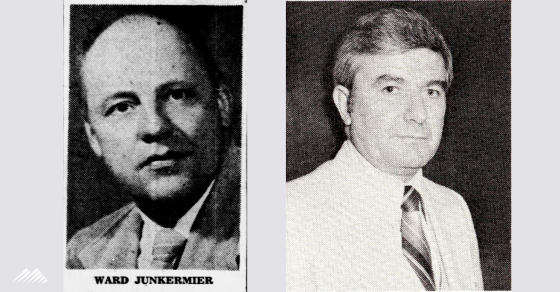
When JCCS first opened in Great Falls 80 years ago, it was a modest operation run by two accountants: founders Ward Junkermier and George Campanella. Today, JCCS has grown into Montana’s largest locally owned public accounting firm, with more than 100 employees across seven locations and clients around the world. The firm’s long journey from its early days to its current statewide presence is a story of hard work, strategic leadership, and a willingness to evolve—starting with Junkermier’s vision.
The Early Years
“Ward was a visionary and great entrepreneur,” says Jerry Lehman, retired shareholder and former CEO.
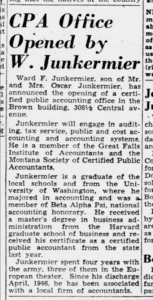
Lehman joined JCCS in 1981, at a time when Junkermier was serving as managing partner. Even then, Junkermier was pushing the firm toward the future.
“He thought we needed to change our structure in the firm to become more like a corporation where there’s a CEO, CFO, and a board of directors,” Lehman recalls.
That idea would eventually take root, alongside other major shifts that shaped the firm’s direction.
In 1964—18 years after opening—Junkermier and Campanella welcomed Maurice Clark and Jack Stevens as partners, officially forming Junkermier, Clark, Campanella, and Stevens, or JCCS. This expansion marked the beginning of a much larger growth strategy.
Over the following decades, JCCS added new locations: Helena in 1970, Missoula in 1980, the Flathead Valley in 1990, and later Hamilton and Bozeman after the turn of the century.
“The decision to grow and become a multi-office firm started with the founders,” Lehman says. “That decision had a lot to do with ensuring our sustainability and relevance. It’s what got us to where we are today.”
Growing Pains
But expansion didn’t automatically translate into unity. For years, JCCS’s offices operated independently, each with its own culture, processes, and even compensation models.
“We didn’t have one big team family culture across the state, and the offices didn’t share resources across the firm,” Lehman says. “Employees were compensated based on how their individual office did, not on the performance of the firm as a whole.”
Tension was building, and the decentralized structure was taking a toll.
“The structure was starting to stress relationships,” he explains. “I knew something had to change and that we couldn’t continue to operate this way. We had to find a way to come together as one team.”
Becoming One Firm
 The transformation from loosely connected offices to a unified organization didn’t happen quickly. It took years of effort, collaboration, and strategic leadership.
“What I’m most satisfied with during my time as CEO is that I worked very, very hard on making that change—to turn the boat around. And successive leadership has continued to build upon that foundation,” Lehman says.
That shift has made JCCS more adaptable and resilient, helping the firm navigate technology changes and external challenges, including the impacts of the COVID‑19 pandemic.
“By pulling ourselves all together and operating as one organization, we’ve been able to strategically integrate new technology and deal with issues outside our control,” Lehman says.
A Legacy That Endures
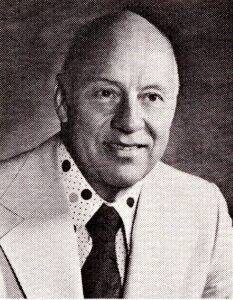
Although Junkermier passed away in 2004, Lehman believes he would be proud of the firm’s evolution and perseverance.
“There are very few firms or businesses in our country that have been around for 80 years,” Lehman reflects. “I don’t see any end in sight, so I don’t know why we couldn’t continue for another 80 years.”
In 2019, The History Museum honored Junkermier with a Legacy Award, recognizing his impact on the accounting profession and the community. His story, which includes an Ivy League education and even a side venture running a logging company, was chronicled in the Great Falls Tribune.
Eighty years after its founding, JCCS continues to embody the forward‑thinking spirit of its early leaders—growing, adapting, and strengthening its commitment to Montana communities.
(Photos: Ward Junkermier & George Campanella; A newspaper clipping dated May 23, 1947; Jerry Lehman; Ward Junkermier, credit: The History Museum)